
Your sales team isn't hitting the targets.
Your people know how to sell. But when deals get difficult...
They talk instead of listening. Avoid the questions that could cost them a deal. Miss signals that a buyer has lost interest. Or push harder when the deal needs a different approach.
By now, you've invested in sales training, coaching, and the tools they need. They know what to do, so why is their performance still inconsistent?
The gap lies in the human behaviors and patterns that get in the way of applying that knowledge when it counts. The Sales Team Performance Accelerator works on the human side of selling, helping your salespeople respond effectively to setbacks, handle difficult conversations, and adapt to changing buyer dynamics.
This helps them turn existing sales knowledge into more consistent execution, without changing your sales methodology.
When sales knowledge isn't the real roadblock

Want your team performing at its best?
The Gap
Everything looks good on paper. But something isn't translating into consistent performance.
➔ They have gotten sales training.
➔ They have done role-play and coaching.
➔ They get your support and feedback.
➔ They have a clear methodology to follow.
➔ They have the tools and analytics.
But still, you’re seeing the same behaviors over and over again:
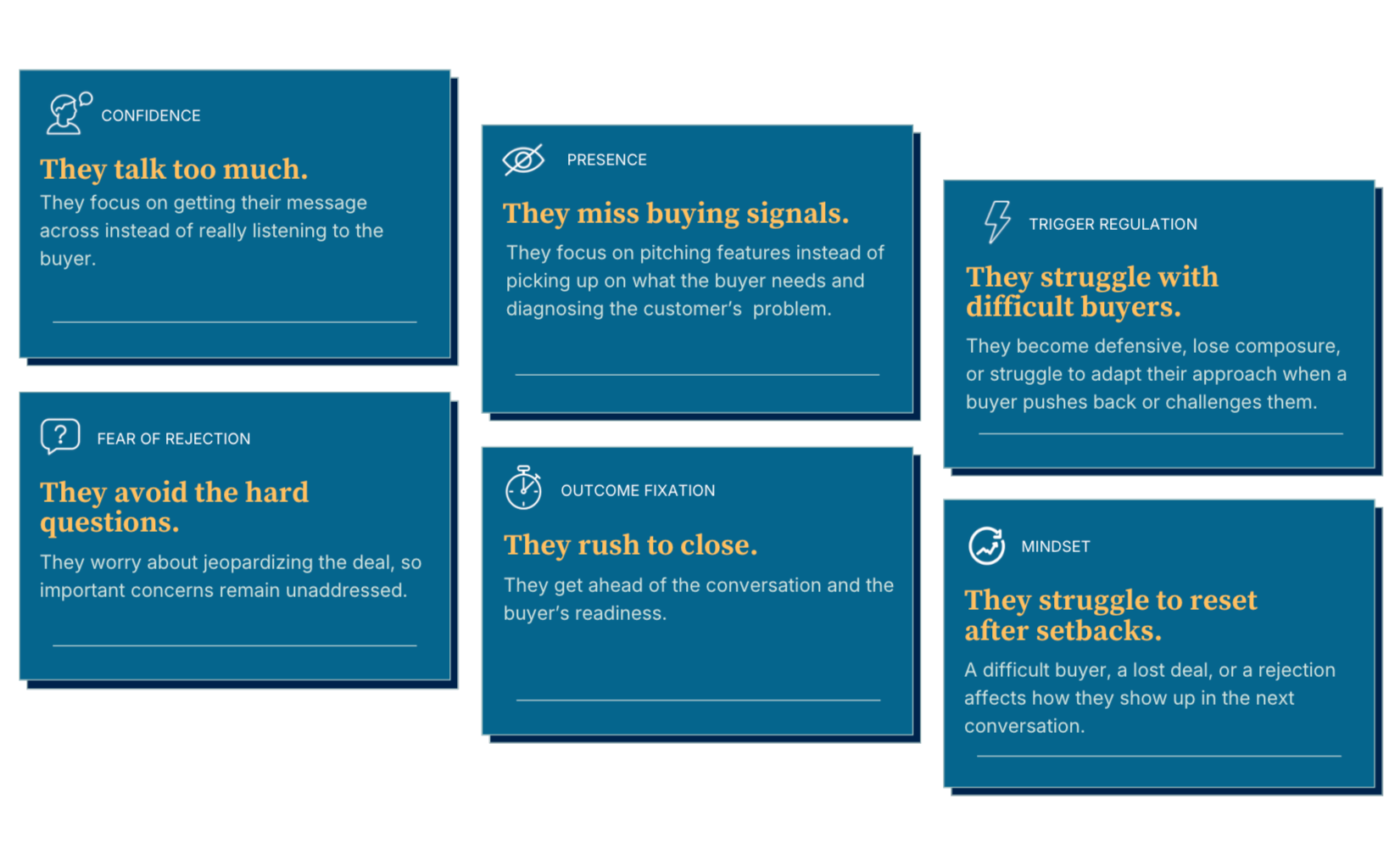
The result? Missed opportunities, stalled deals, and inconsistent results.
So why do the same behaviors keep showing up?
Because knowing what to do and doing it in the moment are two different things.
Rejection, difficult conversations, and setbacks are part of sales. When these situations trigger a stress response, it becomes a lot much harder to think clearly and access what you already know.
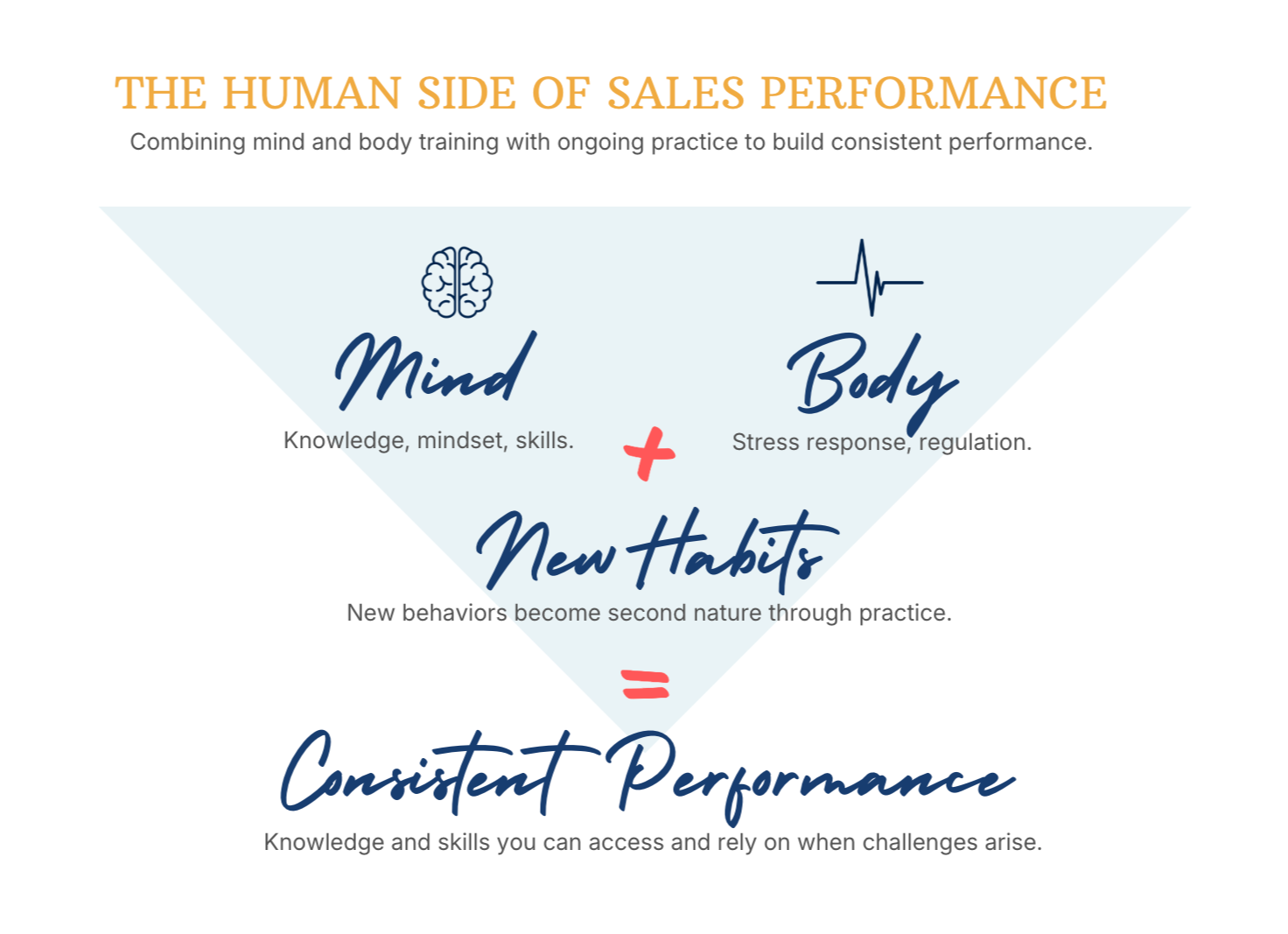
Sales training, coaching, role play, and sales enablement help salespeople build knowledge and skills. But performance isn't purely cognitive. The body plays a key role, too, influencing how we think, feel, and act.
AI makes research, preparation, and admin tasks faster and easier. But winning deals still depends on salespeople building trust, asking the right questions, recognizing buying signals, and adapting to the person in front of them. AI can't do that human work.
That's why this training works with both mind and body, focusing on the cognitive and physiological factors that shape how salespeople perform.
WHAT I ACTUALLY WORK ON
The focus is on the behaviors that shape how your salespeople execute in real situations, before, during, and after a sales conversation.
That means working on how they:
approach difficult buyers with confidence, not defensiveness
stay focused instead of getting caught in their own thoughts
understand buyer priorities instead of defaulting to a familiar pitch
adapt when conversations take an unexpected turn
handle objections and pricing without conceding too quickly
recover after rejection instead of carrying it into the next opportunity
perform consistently across good and bad days
THE SITUATIONS WE WORK WITH
The work connects mindset, physiological responses, and behavior to the situations your salespeople face every day.
We look at what happens when expectations rise, a deal goes sideways, rejection hits, or a difficult customer pushes back. We also look at what happens between interactions, when frustration, self-doubt, or fatigue starts affecting the next task, and how internal competition and conflict affect overall motivation and how people show up at work.
Your salespeople learn practical ways to work with these responses, change unhelpful patterns, and apply new approaches to situations they actually face at work.
For instance:
How do they prepare themselves before an important conversation?
What happens when they lose a big deal they've worked on for weeks?
How do they recover after a bad call without carrying it into the next one?
What happens to their decision-making when the pressure to hit target increases?
How do they stop a mistake from turning into self-doubt?
How do they maintain effective execution when they're tired, frustrated, or challenged?
HOW WE MAKE THE CHANGE
Change doesn't happen through more knowledge. It happens when you pair knowledge with repeated action.
That’s why this training isn't another knowledge dump followed by a pat on the shoulder and a ‘good luck.’
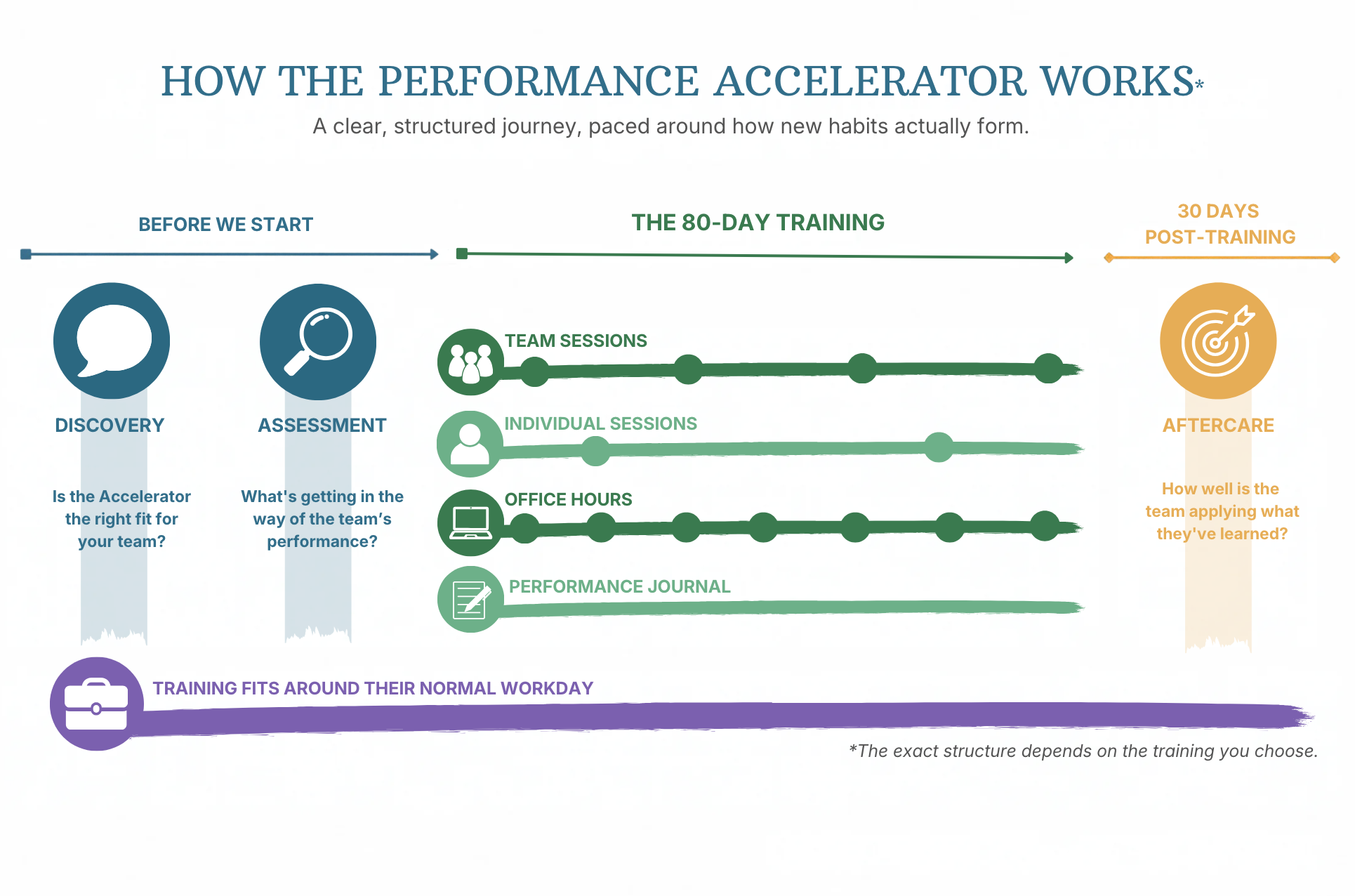
The real work happens when your team puts that knowledge into practice, gets feedback, adjusts, and tries again. The training runs over 80 days, so your team can apply the work from the first session and build on it alongside their actual sales work.
They can ask questions when they have doubts, bring real sales situations back into this training, and work through what happened so they can adjust and apply the learning again. Feedback helps them recognize blind spots, and repeated practice helps them build new behavioral patterns.
WHAT CHANGES
To close that gap, we work on the behaviors that influence how your salespeople perform.
As those behaviors become more consistent, you'll see:
Fewer deals stalling at the same point in the conversation
Less distance between your strongest month and your weakest
Salespeople recovering from a bad call within the hour instead of a day
Difficult buyers handled rather than worked around
Less of your time spent correcting the same patterns
More ownership of their behavior, decisions, and results
Three ways to support your BUsiness
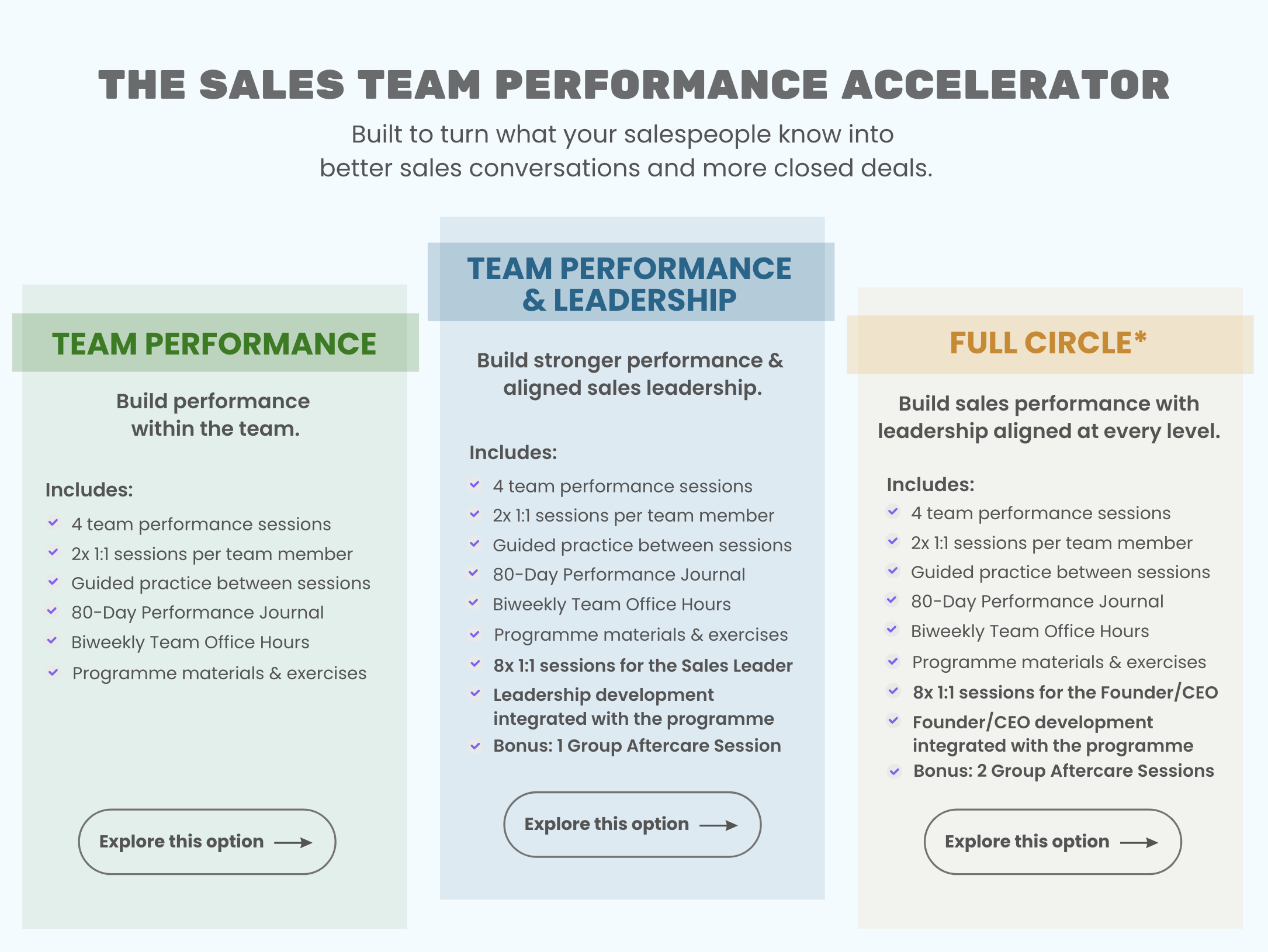
*Full Circle is for founders who recognize that sales performance depends on more than the sales team. When leadership and sales aren't working in sync, even capable salespeople can struggle to deliver the expected results.
EXPERIENCE THE WORK
Get a taste of the work with a focused Performance Session.
Practical 2-hour sessions built around specific performance challenges your sales team faces.
WHY ME
Most of my life, I lived by "mind over matter" and "where there's a will, there's a way," plowing through to the result. But while our brains are fascinating things, I too often forgot that my head has a whole body attached to it.
Pursuing goals with a 'mind first' approach has clear limitations. I hit plenty along the way: struggling to stay calm when things got difficult, not performing at my best when I knew I could, and carrying setbacks into the next day(s). I pushed myself so hard that eventually my body forced me to stop—more than once.
That's when I understood: I wasn't really a "high performer." I was a "push-througher" because I had never included the body in the equation.
That led me deeper into mind and body training, bringing together my psychology and neuroscience knowledge with what I'd learned through combat sports.

Once I started working WITH the body alongside the mind, the pattern vanished. I still have hard days and difficult conversations; I don't lose my ability to think in them, and I don't carry a bad one into the next day. My body hasn't stopped me since.
Reliable high performance is a partnership between the mind and the body: the mind holds all our knowledge, but the body controls when that knowledge is accessible to us.
IS THIS FOR YOUR TEAM?
This is a good fit if:
✓ Your team has the sales knowledge, but performance is still inconsistent.
✓ You see the same behaviors showing up in sales conversations again and again.
✓ You know your people are capable of more.
✓ You've already invested in sales training, coaching, or enablement.
✓ You're ready to help your team turn what they know into how they perform.
This won't be the right fit if:
✗ You're primarily looking for sales knowledge or methodology training.
✗ You're looking for a one-off training to solve performance roadblocks.
✗ You're looking for a quick fix that will change behavior without practice.
✗ Your salespeople aren't motivated to work on the behaviors affecting their performance.
✗ You're looking for training your team can sit back and listen to.
Ready to close the performance gap?
Your team already has the knowledge.
Now let's work on what gets in the way of applying it consistently.
WHAT HAPPENS NEXT?
We talk about your team's performance challenges.
We identify where the gap is.
We decide whether this is the right fit.
Before we talk…
Have a look through the FAQs below. You might find answers to a few questions you already have.
-
Sales training and enablement give your team the knowledge, skills, tools, and resources to sell effectively.
The Sales Team Performance Accelerator focuses on what happens when your salespeople use all of this in a real conversation: how they listen, respond, adapt, handle difficult moments,, and recover when things don't go as planned.
The two work very well together. Sales training and enablement give your team the methodology and tools. This training helps them apply it consistently.
-
No. The training works alongside the sales methodology your team already uses.
The training doesn‘t teach sales processes or ask your team to change how you qualify, structure, or manage opportunities.
The focus is on the human behaviors that affect how consistently your team can apply that methodology in real sales conversations.
-
The packages give you different levels of involvement.
The core work is with your sales team. You can then bring the Sales Leader into the work, and in the Full Circle package, the Founder/CEO too.
The more of the leadership environment is involved, the more effectively the changes can be reinforced across the organization, creating a more lasting and impactful transformation.
-
AI makes research, preparation, and routine tasks faster and easier. But salespeople still need to build relationships, interact with clients, and respond to the person in front of them. You can't expect AI to do the ‘human’ work for you or automate every interaction.
If confidence is low, stress is already affecting their performance, or they struggle to recover after a run of bad calls, no AI tool will fix that.
Sales knowledge and tools don't determine how they perform in practice.
Performance depends on a combination of factors: mindset, resilience, and the ability to think clearly and recover when adversity hits. -
This is for B2B sales teams that already have a sales methodology and the knowledge they need to sell, but aren't consistently translating that into performance.
That can be AEs, SDRs, or both, with their Sales Leader involved. You can also start with a sub-team within a larger sales organization.
The training is designed for teams of up to 12 people.
There should also be a clear performance gap that can be addressed through changes in behavior. If the issue is primarily the targets, sales model, or wider commercial setup, this isn't the right intervention.
-
The accelerator runs over 80 days, with training sessions, practice, and support throughout. Your team starts applying the work from the first session, then builds on it through the training as they learn, practice, receive feedback, and work on deeper-level challenges.
The 180 days give those changes time to take hold while they continue their normal sales work.About a month after the accelerator ends, an aftercare session reviews how the changes are holding up and addresses anything that still needs attention.
-
The investment depends on your team size and the level of support you choose.
I offer three accelerator options, ranging from team performance training to more comprehensive training that includes individual leadership work with the Sales Leader and Founder/CEO to fine-tune the leadership and environment that shape sales performance.
Book a call, and I'll walk you through the options, answer your questions, and help you decide which training makes the most sense for your team.
Ready to talk about the next steps?
Let's talk about what your team needs and how we can close the performance gap.